 Reviews



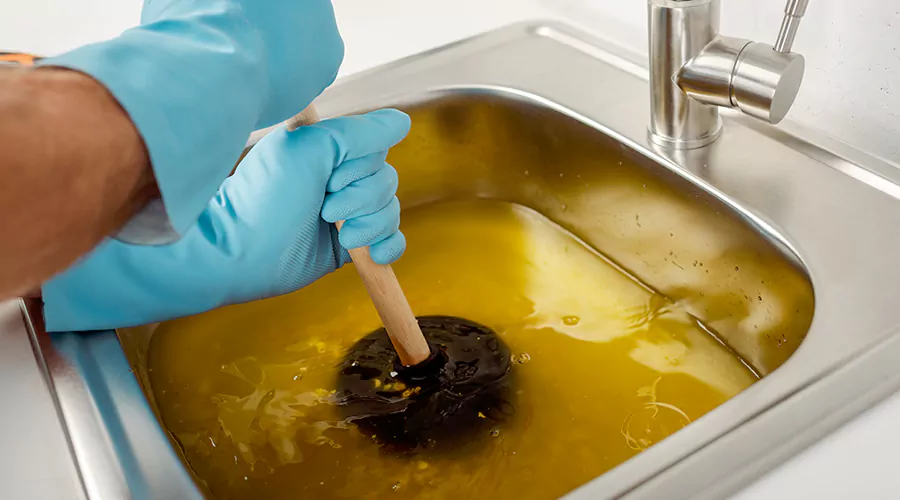
A kitchen drain is most often clogged because grease coats the inside of the pipe and traps food debris. A local kitchen sink clog can cost about $110 to $215 to clear professionally in 2026, while broader drain cleaning averages $246.
The supplied keyword kitchen drain clogged has 5,000 average monthly searches.
Understanding the cause matters because grease requires a different prevention strategy from a jammed garbage disposal or a blockage farther downstream.
Why Does Grease Clog a Kitchen Drain?
Cooking grease can enter the sink as a warm liquid and then cool inside the drain. Once it sticks to the pipe wall, food particles collect against the greasy surface. The opening becomes smaller over time.
- Oil can contribute to the same problem.
- The grease does not need to form a solid plug by itself.
- Its main effect is creating a sticky surface.
- Food then adds volume.
- The process repeats every time more residue enters the drain.
This explains why grease clogs often develop gradually.
What Food Causes Kitchen Drain Problems?
Food should be kept out of the drain whenever possible because several types can collect inside the trap or attach to existing grease.
- Rice can swell after absorbing water.
- Coffee grounds can settle into dense material.
- Food scraps can lodge at pipe turns.
- Fibrous material can create problems in a garbage disposal.
The supplied keyword kitchen sink garbage disposal has 5,000 average monthly searches. A disposal reduces food size. It does not make every type of food safe for drainage piping. The drain still needs enough water to carry ground material away.
Can the Garbage Disposal Cause a Clogged Drain?
Yes. A garbage disposal can contribute to a blockage when it is jammed or when food remains in the discharge pipe. A disposal that spins normally can still feed material into a partially blocked drain.
- Check whether the disposal operates.
- Listen for humming.
- Observe whether water drains from the disposal side.
- Turn off power before inspecting the unit.
- Never reach into the grinding chamber.
A clogged garbage disposal and a clogged drain can produce similar standing-water symptoms. One affects the appliance. The other affects the piping. Diagnosis should separate them before repair begins.
Can the P-Trap Cause the Problem?
The P-trap beneath the sink holds water to block sewer gas. Its curved design can also collect food or grease when enough material enters the drain.
- A trap clog normally affects the kitchen sink directly.
- It can often be inspected by removing the curved section.
- Place a bucket underneath.
- Open the trap.
- Check for debris.
- Clean the inside.
- Inspect the washers before reassembly.
Home Depot recommends P-trap inspection when surface methods fail to clear a kitchen sink. If the trap is empty but the sink remains blocked, the restriction lies farther down the waste line.
Can the Kitchen Sink Drain Pipe Be Clogged?
Yes. Grease can build up beyond the P-trap inside the horizontal branch pipe. This deeper restriction can be harder to reach because surface tools may only disturb the near edge of the blockage.
The supplied keyword kitchen sink drain pipe has 5,000 average monthly searches.
A deeper clog becomes more likely when:
- The trap is clean.
- Both sink bowls back up.
- The clog quickly returns.
- A plunger gives only temporary improvement.
- A manual auger meets resistance inside the wall pipe.
This type of blockage needs mechanical access farther downstream. A longer snake may be required.
How Does a Kitchen Drain Clog Progress?
Kitchen clogs usually develop gradually as the available opening becomes smaller. A slow sink is the first useful warning because water is still passing through the drain.
| Stage | What You Notice | Likely Cause | 2026 Cost Exposure |
|---|---|---|---|
| Early | Slightly slow drain | Grease coating | Often DIY |
| Partial | Water pools | Grease plus food | Low DIY cost |
| Severe | Standing water | Dense blockage | $110 to $215 |
| Widespread | Other drains affected | Deeper system clog | $147 to $352+ |
Professional drain cleaning costs between $147 and $352 in 2026. Addressing the early stage reduces the amount of material that has to be removed later.
What Warning Signs Reveal the Type of Clog?
The behavior of the sink can tell you more than the presence of standing water alone. A disposal issue has different clues from a branch-line clog.
- Water drains slowly after greasy dishes are washed. Grease buildup is likely.
- The disposal hums without turning. The disposal may be jammed.
- Water backs into the second sink bowl. The clog is probably after the shared connection.
- Food odor comes from the drain. Organic material may be trapped.
- The P-trap repeatedly fills with debris. Food is entering the sink too often.
- Plunging works only temporarily. The restriction may be deeper.
- The trap is clean but water stays in the sink. The branch pipe may be clogged.
- Several drains become slow. The restriction may be beyond the kitchen.
- Gurgling appears in multiple fixtures. Air movement is being affected farther downstream.
- Wastewater returns through the sink. A larger drainage problem is possible.
These symptoms help decide where to inspect first.
Can Dishwasher Use Reveal a Kitchen Drain Clog?
Yes. Many dishwashers discharge into the garbage disposal or kitchen drain. Water can return into the sink when the shared drain is already restricted.
- Watch the sink during a dishwasher drain cycle.
- If water rises into the basin, inspect the kitchen waste line.
- Check the disposal.
- Confirm that the dishwasher connection is clear.
- Do not assume the dishwasher itself is leaking.
The shared drain can be the reason water appears during appliance operation. A clog after the disposal connection affects both systems.
What DIY Test Can Identify the Clog Location?
A staged water test can help identify where the restriction sits.
- Remove visible food first.
- Run water into one sink bowl.
- Watch the second bowl.
- Turn the disposal on when appropriate.
- Stop the water.
- Observe how long drainage takes.
If both bowls react, inspect the shared plumbing. If only the disposal side is affected, check the disposal and outlet. If the P-trap is removed and clean, the blockage is farther into the drain line. This simple sequence prevents random part replacement.
When Should You Call a Professional?
Professional diagnosis is useful when the blockage remains beyond the reach of a hand auger or more than one fixture becomes slow. Repeated kitchen clogs also deserve inspection because the underlying pipe may contain substantial grease buildup.
Kitchen sink drain cleaning costs about $110 to $215 in 2026. Broader drain cleaning averages $246.
Professional help makes sense when:
- The P-trap is clear.
- The hand auger cannot restore drainage.
- Several drains are affected.
- Wastewater backs up repeatedly.
- The drain pipe leaks.
- The clog returns soon after mechanical clearing.
A professional may use larger drain equipment when the buildup extends farther through the branch line. Kitchen plumbing services can help diagnose and clear deeper restrictions when basic methods do not restore proper drainage.
How Can You Prevent a Kitchen Drain Clog?
Keeping grease and food out of the sink is more effective than routine emergency cleaning.
- Let cooking fat cool.
- Dispose of it in the trash according to local waste guidance.
- Use a sink strainer.
- Scrape dishes before washing.
- Avoid sending coffee grounds into the drain.
- Use the garbage disposal only for suitable food waste.
- Clean the drain when it first becomes slow.
The strongest prevention habit is simple. The drain should carry wastewater rather than kitchen scraps.
Conclusion
If you are asking why is my kitchen drain clogged, grease and food buildup are the first conditions to investigate. Check the strainer and disposal before inspecting the P-trap. A clean trap combined with continued backup points toward the branch pipe. If other fixtures become slow or the clog repeatedly returns, the problem may be deeper. This week, change how cooking grease is disposed of before more buildup reaches the drain.
Frequently Asked Questions
Can cooking oil clog a kitchen drain?
Yes. Oil can coat the pipe wall and make it easier for food residue to stick.
Why does my kitchen drain smell bad?
Food or grease can remain inside the trap or drain pipe long enough to create odor.
Why does the kitchen drain clog every few months?
Grease may be building deeper in the branch pipe rather than being fully removed during each clearing attempt.
Can a disposal prevent kitchen clogs?
A disposal reduces food size but does not make grease or unsuitable food safe for the drain.
Why are several drains slow at once?
The restriction may be farther downstream than the individual kitchen sink branch.